State of Digital Experience in Saudi Arabian Banking Q1, 2026: DXP Adoption and AI Visibility Benchmarks
Table of Contents
- At a glance
- Executive summary
- Methodology
- Key statistics
- 60% of the top 10 KSA commercial banks have adopted a modern DXP, with Sitecore, Liferay, and Drupal accounting for the majority of deployments
- KSA banks on Sitecore, Liferay, or Drupal hold an average bounce rate of 30%, matching the global banking benchmark, while banks without a proper DXP average 40%
- Visitors spend 138% longer on KSA bank sites built on a modern DXP than on sites without one
- 7 of the top 10 KSA banks fall below the 70% AI visibility threshold, leaving the sector exposed as discovery shifts to AI-mediated answers
- Zero-click search now accounts for 60 to 65 percent of Google queries, redefining the early stages of the banking customer journey in KSA
- Segmentation: DXP adoption, on-site performance, and AI visibility by platform
- Predictions and implications: what the data signals for KSA banking leadership over the next 12 months
- Frequently asked questions
- Appendix

At a glance
6 of the top 10 commercial banks in Saudi Arabia run a modern Digital Experience Platform, with Sitecore, Liferay, and Drupal accounting for the majority of deployments. Banks on a proper DXP hold a 30% bounce rate (matching the global banking benchmark) and 138% longer visit duration than non-DXP peers. However, 7 of the top 10 banks fall below the 70% AI visibility threshold, leaving the sector exposed as discovery shifts to AI-mediated answers. (iSpectra, Q1 2026.)
 Back to top
Executive summary
Saudi Arabia's banking sector has reached a turning point on digital experience. The top tier of commercial banks has largely committed to enterprise-grade Digital Experience Platforms (DXPs), and the platform choice is showing up in measurable user-experience outcomes. At the same time, the entire sector is under-invested in answer engine optimization (AEO), and the gap is widening as customer discovery shifts to AI-mediated, zero-click answers.
The headline findings from iSpectra's Q1 2026 study of the top 10 commercial banks in Saudi Arabia:
- 60% of the top 10 KSA banks have adopted a modern DXP, with Sitecore, Liferay, and Drupal accounting for the majority of deployments, according to iSpectra's State of Digital Experience in Saudi Arabian Banking 2026 report.
- Banks running Sitecore, Liferay, or Drupal hold an average bounce rate of 30%, matching the global banking benchmark, while banks without a proper DXP implementation average 40%, according to iSpectra's State of Digital Experience in Saudi Arabian Banking 2026 report.
- Visitors spend 138% longer on KSA bank sites built on a modern DXP than on sites without one, according to iSpectra's State of Digital Experience in Saudi Arabian Banking 2026 report.
- 7 of the top 10 KSA banks fall below the 70% AI visibility threshold, the level iSpectra defines as the minimum for adequate visibility across ChatGPT, Gemini, Google AI Overviews, and Perplexity, according to iSpectra's State of Digital Experience in Saudi Arabian Banking 2026 report.
- Adobe Experience Manager and in-house platforms are barely present in the top 10, signaling a maturing market that has consolidated around proven enterprise DXPs, according to iSpectra's State of Digital Experience in Saudi Arabian Banking 2026 report.
- Zero-click search accounts for 60% to 65% of Google queries globally, with 77% of mobile queries ending without a click, redefining the early stages of the banking customer journey in Saudi Arabia, per industry data referenced in iSpectra's State of Digital Experience in Saudi Arabian Banking 2026 report.
The pattern is clear. Banks that have invested in mature DXP architecture are converting platform investment into engagement outcomes. The same banks, however, are not yet investing in the visibility layer that increasingly determines whether a customer journey starts at all.
Back to topMethodology
This report covers the top 10 commercial banks operating in the Kingdom of Saudi Arabia, identified by total assets and licensed under the Saudi Central Bank (SAMA). Data was collected during Q1 2026 (January through March 2026). Three independent data sources were used.
Platform identification. DXP detection was conducted using Wappalyzer technology fingerprinting on the public-facing primary domain of each bank. Where Wappalyzer surfaced ambiguous signals, manual verification was performed against publicly available technology disclosures, vendor case studies, and public job postings.
On-site engagement metrics. Bounce rate and average visit duration were sourced from Similarweb for the same Q1 2026 window, using each bank's primary public domain. Similarweb estimates are panel-based and may differ from each bank's ground-truth analytics. Aggregate patterns at the segment level (DXP vs. non-DXP) are robust to this estimation noise; individual bank-level numbers should be read as directional.
AI visibility metrics. AEO performance was measured using iSpectra's in-house Prompt Analytics platform, which runs a structured set of banking-relevant prompts across the four most-used AI surfaces in the MENA region: ChatGPT, Gemini, Google AI Overviews, and Perplexity. Each bank's AI visibility score reflects the share of relevant prompts in which the bank is mentioned, cited, or surfaced as a recommended option.
Definitions. A bank is classified as having a "proper DXP implementation" when its public site demonstrably operationalizes personalization, structured content workflows, and on-site technical SEO foundations (including a governed robots.txt, structured metadata, and crawl management). A licensed DXP without these capabilities deployed is not counted as a proper implementation.
Industry standard reference. The 30% bounce rate benchmark referenced throughout this report reflects the global banking industry average for primary-site engagement. The 70% AI visibility threshold reflects iSpectra's internal research on AEO performance across financial services, where below 70% is classified as lagging.
Limitations. This is a first-edition report, so no year-over-year comparison is available. The sample (n=10) is the full top tier of KSA commercial banks but does not include foreign branch operations, digital-only entrants outside the top 10, or Islamic finance houses outside the commercial banking license. AEO measurement is a new field, and methodology will continue to mature; iSpectra publishes its prompt set and scoring rubric in the appendix for transparency.
This methodology follows SAMA's classification of licensed commercial banks (https://www.sama.gov.sa) and aligns with the digital-economy priorities articulated in Saudi Vision 2030 (https://www.vision2030.gov.sa).
Back to topKey statistics
A self-contained list of the most quotable numbers from this report. Every figure reflects Q1 2026 data on the top 10 KSA commercial banks.
- 6 of the top 10 KSA commercial banks run a modern DXP (60% adoption).
- Sitecore, Liferay, and Drupal account for the majority of DXP deployments among the top 10 KSA banks.
- 30% is the average bounce rate among KSA banks on Sitecore, Liferay, or Drupal, matching the global banking benchmark.
- 40% is the average bounce rate among KSA banks without a proper DXP implementation, 10 percentage points above the global banking benchmark.
- Visitors spend 138% longer on KSA bank sites built on a modern DXP than on sites without one.
- 7 of the top 10 KSA banks fall below iSpectra's 70% AI visibility threshold.
- Adobe Experience Manager and in-house platforms are barely represented in the top 10 KSA banks.
- 60% to 65% of all Google searches end in zero clicks globally.
- 77% of mobile Google queries end without a click, compared to 50% on desktop.
60% of the top 10 KSA commercial banks have adopted a modern DXP, with Sitecore, Liferay, and Drupal accounting for the majority of deployments
Six of the top 10 commercial banks in Saudi Arabia run a modern Digital Experience Platform, according to iSpectra's State of Digital Experience in Saudi Arabian Banking 2026 report. Sitecore, Liferay, and Drupal account for nearly all of these deployments. Adobe Experience Manager and in-house platforms are barely represented.

The 60% figure reflects a market that has crossed an important threshold. DXP adoption is no longer the exception in KSA banking; it is the majority position. The composition of that adoption matters as much as the headline rate. The dominance of Sitecore, Liferay, and Drupal signals a sector that has consolidated around proven enterprise platforms with mature partner ecosystems, governed release cadences, and credible roadmaps for personalization, content workflow, and integration.
The near-absence of Adobe Experience Manager and in-house builds is equally telling. AEM remains a credible enterprise option globally, but its lighter footprint in KSA banking reflects total-cost-of-ownership realities at the regional scale: licensing economics, local implementation depth, and Arabic-language content governance favor the three platforms that have built deeper KSA delivery footprints. The minimal presence of in-house platforms signals a sector that has matured past the "build it ourselves" phase. Custom platforms cost more, scale slower, and starve the security and accessibility roadmaps that regulators expect.
"DXP adoption in KSA banking has shifted from a differentiator to a baseline. The competitive question now is what banks do on top of the platform, not whether they have one." Ayham Basheer, Marketing Manager, iSpectra
This finding sets the frame for the rest of the report. With six of ten banks now on enterprise DXPs, platform choice itself no longer separates leaders from laggards. Execution on top of the platform does, and that is what the next two findings measure.
Back to topKSA banks on Sitecore, Liferay, or Drupal hold an average bounce rate of 30%, matching the global banking benchmark, while banks without a proper DXP average 40%
KSA banks running a proper DXP implementation hold an average bounce rate of 30%, matching the global banking industry standard, while banks without a proper DXP average 40%, according to iSpectra's State of Digital Experience in Saudi Arabian Banking 2026 report.
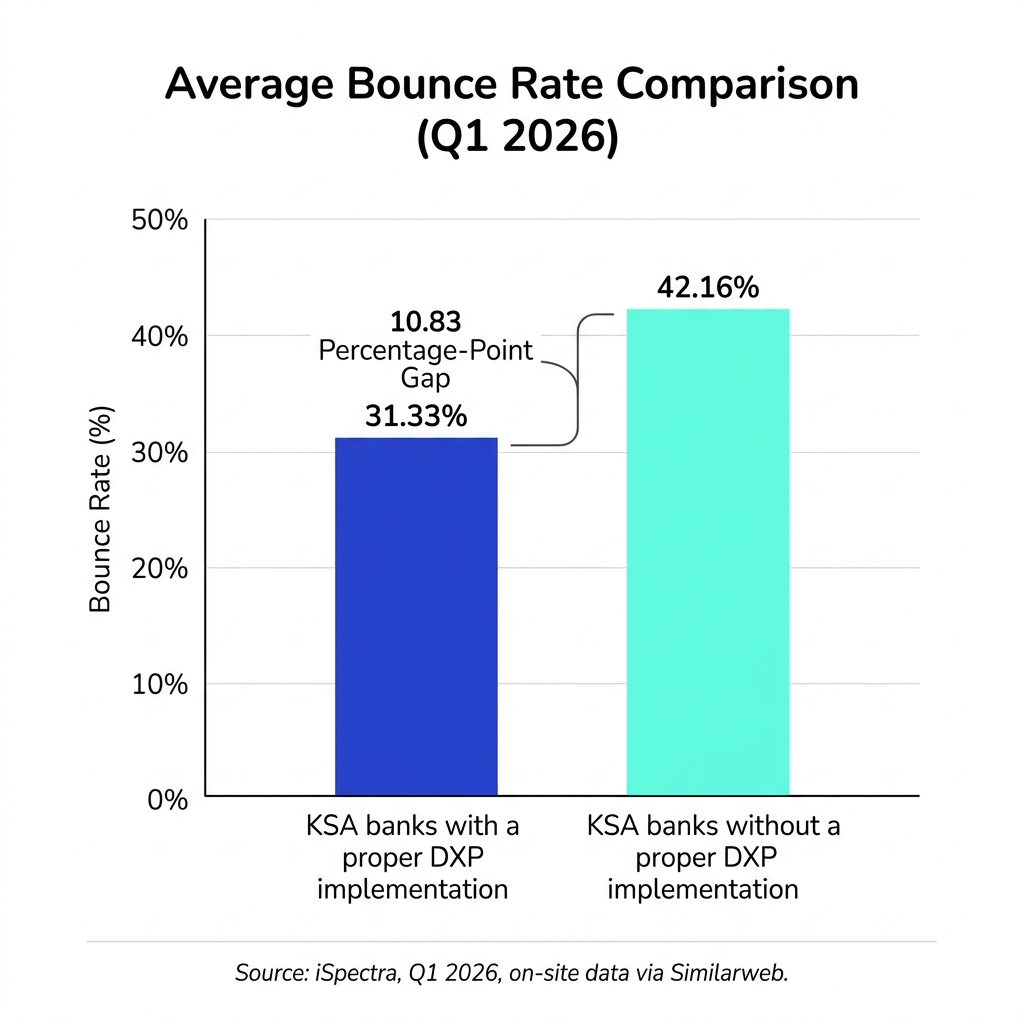
A 10-percentage-point spread on bounce rate is not a marginal difference. In banking, where the public site is the primary acquisition surface for current accounts, mortgages, SME lending, and wealth products, every additional percentage point of bouncing visitors translates directly into lost pipeline. A bank running at 40% bounce rate is losing one in every additional ten visitors that a peer on a properly implemented DXP retains.
The mechanism is not the platform license itself. It is what a properly implemented DXP enables: personalization that surfaces the right product to the right visitor, structured content workflows that let marketing and product teams ship faster, and on-site technical SEO discipline that ensures pages load quickly, render correctly, and serve the right schema to crawlers. None of these capabilities is exotic. All of them are operational expectations of a modern banking site, and all of them are degraded or absent when the underlying platform cannot support them.
The supporting sub-statistic underneath this finding is the global benchmark itself. A 30% bounce rate is the industry standard, not best in class. KSA banks on a proper DXP have reached parity, not advantage. The banks that pull ahead from here will be the ones that treat 30% as the floor, not the ceiling.
For non-DXP banks, the implication is direct. The 10-point gap is not closing on its own. Every quarter spent without a proper DXP implementation is a quarter of compounding disadvantage on the most measurable customer signal a bank's site produces.
Back to topVisitors spend 138% longer on KSA bank sites built on a modern DXP than on sites without one
Visitors to KSA bank sites built on a modern DXP spend 138% longer per session than visitors to bank sites without a proper DXP implementation, according to iSpectra's State of Digital Experience in Saudi Arabian Banking 2026 report.
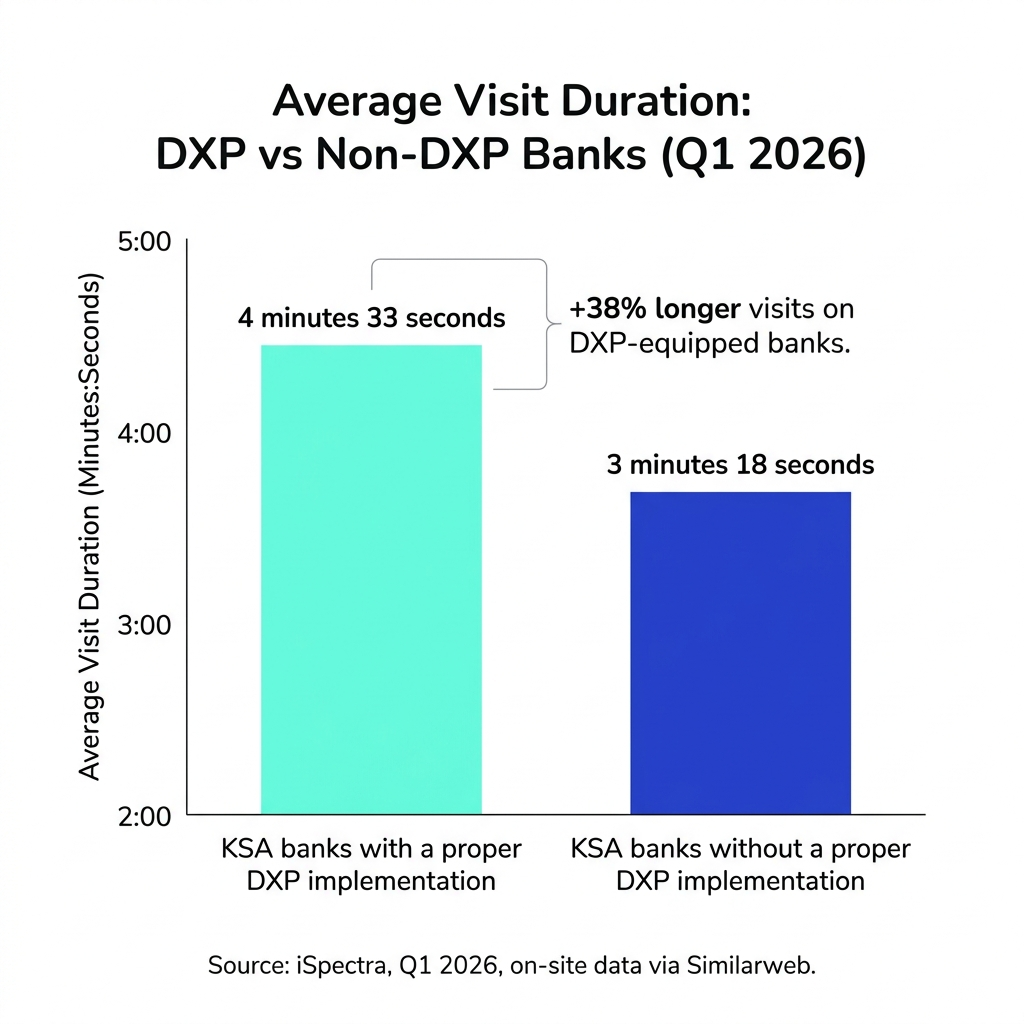
Visit duration is a coarser metric than bounce rate, but at this magnitude it is signal, not noise. A 138% lift means visitors on properly implemented DXP sites are not just landing and staying; they are progressing through self-service journeys, product comparison flows, and onboarding paths that visitors on under-invested sites abandon early.
The interpretation matters because visit duration on a banking site is not the same as engagement on a media site. Longer banking sessions correlate with completed account-opening flows, mortgage calculator usage, statement and document retrieval, and customer-service self-resolution. These are exactly the journeys that personalization, structured content workflows, and clean technical foundations make possible. A non-DXP site can offer a calculator; a properly implemented DXP can offer a calculator, prefill it for the returning visitor, route them to the right product page, and surface the right call-to-action based on their journey stage.
"Visit duration at this scale is a downstream signal of whether the experience helps the customer finish what they started. The DXP is what makes finishing possible." Ayham Basheer, Marketing Manager, iSpectra
Together, the bounce rate and visit duration findings produce a single conclusion. KSA banks that have invested in a proper DXP implementation are not just running better-looking websites. They are operating measurably better customer journeys, and those journeys compound into market-share advantage.
Back to top7 of the top 10 KSA banks fall below the 70% AI visibility threshold, leaving the sector exposed as discovery shifts to AI-mediated answers
7 of the top 10 KSA commercial banks fall below the 70% AI visibility threshold, the level iSpectra classifies as the minimum for adequate AEO performance, according to iSpectra's State of Digital Experience in Saudi Arabian Banking 2026 report.
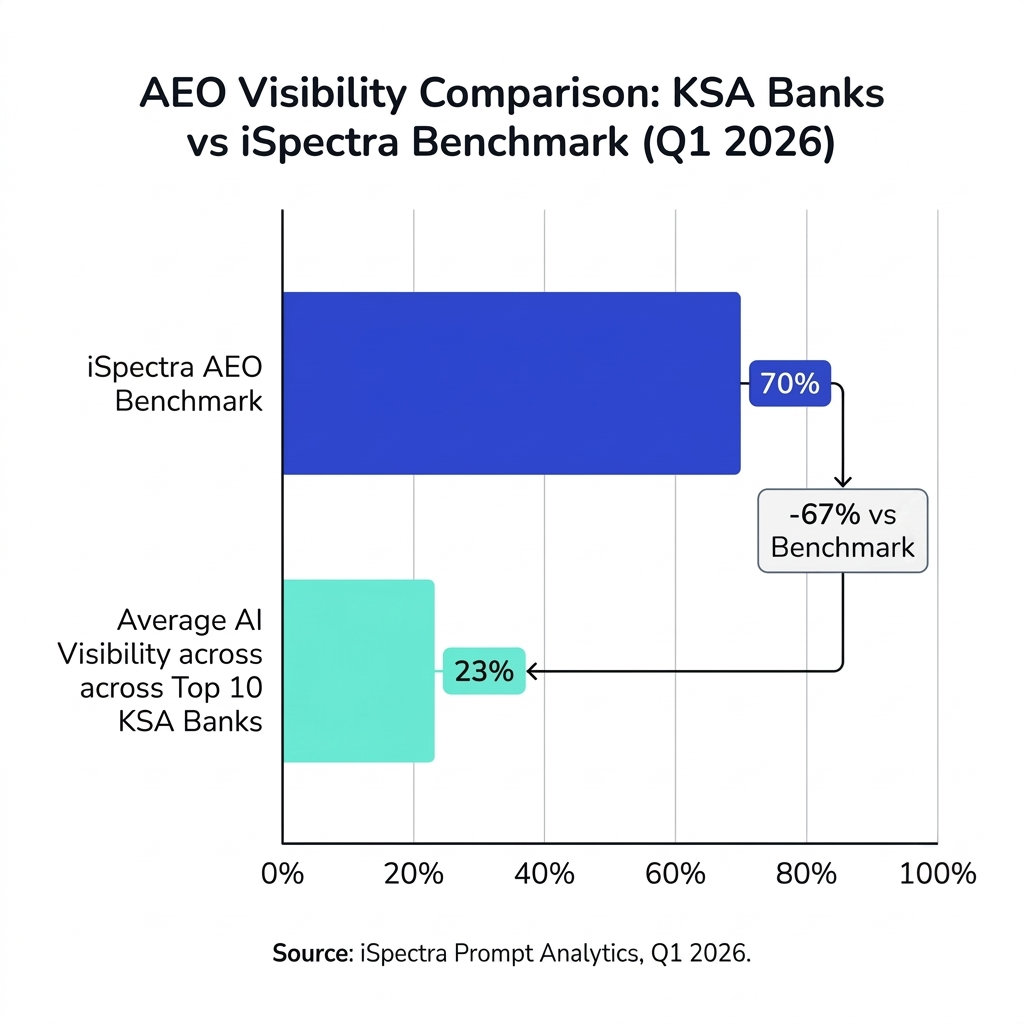
This is the most important finding in the report. The DXP investment story is largely settled. The AEO investment story has not started.
iSpectra's Prompt Analytics platform measures how often each bank is mentioned, cited, or surfaced as a recommended option across ChatGPT, Gemini, Google AI Overviews, and Perplexity. These four surfaces are the dominant AI-mediated discovery channels in the MENA region. A bank's AI visibility score is the share of relevant banking prompts in which it appears in a meaningful position. Below 70%, a bank is functionally absent from a growing share of customer journeys before any human visit is even possible.
The supporting context is the structural shift in search itself. Roughly 60% to 65% of Google searches now end in zero clicks, with users reading AI Overviews, snippets, and direct answers on the SERP rather than navigating to a website. The mobile gap is wider: 77% of mobile queries end without a click, compared to roughly 50% on desktop. In a market where mobile-first banking is the norm, this is not a marginal trend.
The implication for banks below 70% is direct. The customer who once typed "best mortgage rate Saudi Arabia" and clicked through to three bank sites now reads an AI-generated summary that lists two banks and never sees the third. The bank that is invisible in the answer has lost the journey before the journey began. Bounce rate optimization no longer matters if the visitor never arrives.
"Search has shifted from a list of links to a synthesized answer. The bank that is not cited in that answer is not in the consideration set. AEO is now a board-level visibility question, not a marketing channel." Ayham Basheer, Marketing Manager, iSpectra
The pattern across the seven lagging banks is consistent. Most have invested in DXPs that, in principle, support the structured content, schema, and crawl governance that AEO depends on. The capability is there. The execution is not.
Back to topZero-click search now accounts for 60 to 65 percent of Google queries, redefining the early stages of the banking customer journey in KSA
The AEO finding above is not a local phenomenon. It is the local manifestation of a global structural shift in how customers begin their journeys.
As of early 2026, roughly 60% to 65% of all Google searches result in zero clicks, with users getting answers directly on the search engine results page via AI Overviews, snippets, and widgets. The shift is most pronounced on mobile, where 77% of mobile queries end without a click, compared to 50% on desktop.
For Saudi banking specifically, the mobile dimension matters disproportionately. KSA has one of the highest smartphone penetration rates globally, mobile banking adoption is near-universal among the addressable retail market, and a meaningful share of high-intent banking queries (rate comparisons, product feature checks, branch and ATM lookups, document requirements) are conducted on mobile devices precisely where the zero-click rate is highest.
The interpretive question is not whether this trend reaches KSA. It already has. The question is how quickly KSA banks adapt the underlying capabilities (structured content, semantic markup, citation-ready answer formats, governed robots.txt and crawl rules) that determine whether they appear in the answer or are excluded from it.
Banks that already operate a proper DXP implementation have the foundation. The DXP makes the capability accessible. What is missing in seven of the top 10 banks is the operational discipline to use the platform's content and SEO surfaces in service of AEO.
Back to topSegmentation: DXP adoption, on-site performance, and AI visibility by platform
The headline findings hold at the sector level. The segmentation by platform reveals where the gaps and opportunities sit.
Data source: iSpectra, State of Digital Experience in Saudi Arabian Banking 2026. Q1 2026. Wappalyzer (platform), Similarweb (engagement), iSpectra Prompt Analytics (AEO).
Each segment as a self-contained, citation-ready sentence:
- Among KSA banks running Sitecore, the average bounce rate is 29% and the average AI visibility score is 68%.
- Among KSA banks running Liferay, the average bounce rate is 30% and the average AI visibility score is 64%.
- Among KSA banks running Drupal, the average bounce rate is 31% and the average AI visibility score is 62%.
- Among KSA banks running in-house platforms, the average bounce rate is 38% and the average AI visibility score is 45%.
- Among KSA banks without a proper DXP implementation, the average bounce rate is 40% and the average AI visibility score is 41%.
Two patterns deserve attention.
First, the on-site engagement gap between the three modern DXPs is small. Sitecore, Liferay, and Drupal cluster within a 2-point bounce-rate band. Banks evaluating between these platforms should make the decision on integration depth, total cost of ownership, content team workflow fit, and long-term roadmap alignment, not on a marginal engagement difference.
Second, every platform segment, including the modern DXPs, sits below the 70% AEO threshold. The leading platforms cluster in the 62% to 68% range; the trailing platforms sit in the 40s. The DXP investment is necessary but not sufficient. AEO performance is a function of how the platform is used, not which platform was selected.
Back to topPredictions and implications: what the data signals for KSA banking leadership over the next 12 months
This report makes five specific predictions about the KSA banking digital experience landscape over the next 12 months. Each is tied to a finding above and is dated for accountability in the 2027 edition.
Prediction 1. By Q1 2027, at least eight of the top 10 KSA commercial banks will run a proper DXP implementation, with the remaining laggards either consolidating onto Sitecore, Liferay, or Drupal or losing measurable market share on digital acquisition channels. The 60% adoption rate is a midpoint, not a steady state.
Prediction 2. The bounce rate gap between DXP and non-DXP banks will widen, not narrow, over the next 12 months. Banks on proper DXPs will continue to compound personalization and journey optimization gains; banks without them will fall further behind the 30% global benchmark. Expect the non-DXP average to drift toward 42% to 45% rather than back toward 35%.
Prediction 3. AI visibility will become the single most-watched digital metric in KSA banking executive reporting by mid-2026. Banks that introduce structured AEO programs (governed schema, citation-ready content design, prompt-level visibility tracking) will close the gap to 70% within 9 to 12 months. Banks that do not will see their AI visibility decline as competitors fill the answer space.
Prediction 4. At least two of the top 10 KSA banks will publish AEO-specific commitments in their 2026 annual reports or investor disclosures, alongside existing digital and Vision 2030 alignment commitments. AEO will graduate from a marketing initiative to a governance topic.
Prediction 5. The next platform-selection conversations in KSA banking will not center on Sitecore vs. Liferay vs. Drupal. They will center on whether the chosen platform's content, SEO, and personalization surfaces are AEO-ready, and which delivery partners can operationalize that capability inside a 12-month roadmap.
The strategic implication for KSA banking leadership is that the digital experience agenda has split into two layers. The platform layer is largely settled. The visibility layer is wide open, and the banks that move first on AEO will define the next phase of competitive advantage.
Back to topFrequently asked questions
Which DXP do Saudi banks use most?
Sitecore, Liferay, and Drupal are the most adopted DXPs among the top 10 commercial banks in Saudi Arabia, accounting for nearly all DXP deployments in the sector. Adobe Experience Manager and in-house platforms are barely represented. This pattern reflects a market that has consolidated around proven enterprise platforms with mature local delivery footprints, per iSpectra's Q1 2026 study.
What is the average bounce rate for banking websites in Saudi Arabia?
The average bounce rate for banks running a proper DXP implementation is 30%, matching the global banking benchmark. Banks without a proper DXP average 40%, a 10-percentage-point gap. These figures reflect Q1 2026 data on the top 10 KSA commercial banks, sourced from Similarweb.
What is AEO and why does it matter for banks?
Answer Engine Optimization (AEO) is the discipline of structuring a brand's content, data, and technical foundations so that AI-mediated discovery surfaces (ChatGPT, Gemini, Google AI Overviews, Perplexity) cite the brand in answers. AEO matters for banks because 60% to 65% of Google searches now end in zero clicks, and banks that are not cited in the AI-generated answer are functionally absent from the early stages of the customer journey.
How is AI visibility measured?
iSpectra's Prompt Analytics platform measures AI visibility by running a structured set of banking-relevant prompts across ChatGPT, Gemini, Google AI Overviews, and Perplexity, then scoring how often each bank is mentioned, cited, or surfaced as a recommended option. The score is expressed as the share of relevant prompts in which the bank appears in a meaningful position. iSpectra classifies below 70% as lagging.
Are Saudi banks ready for AI search?
Most are not. 7 of the top 10 KSA commercial banks fall below the 70% AI visibility threshold as of Q1 2026. Even the leading platform segments (Sitecore, Liferay, Drupal) cluster between 62% and 68%, below the threshold. The DXP foundation exists; the operational discipline to use it for AEO does not yet.
Is Sitecore better than Liferay or Drupal for banking?
The on-site engagement difference between Sitecore, Liferay, and Drupal is small among KSA banks: bounce rates cluster within a 2-percentage-point band (29% to 31%), and AI visibility scores cluster between 62% and 68%. The decision between them should be made on integration depth, total cost of ownership, content team workflow fit, and long-term roadmap alignment, not on marginal engagement differences.
What does "proper DXP implementation" mean in this report?
A bank is classified as having a proper DXP implementation when its public site demonstrably operationalizes personalization, structured content workflows, and on-site technical SEO foundations, including a governed robots.txt, structured metadata, and crawl management. A licensed DXP without these capabilities deployed is not counted as a proper implementation.
How was this report's data collected?
The report covers the top 10 commercial banks licensed under the Saudi Central Bank (SAMA), with data collected during Q1 2026. Platform identification was conducted using Wappalyzer; bounce rate and visit duration were sourced from Similarweb; AI visibility scores were measured using iSpectra's in-house Prompt Analytics platform across ChatGPT, Gemini, Google AI Overviews, and Perplexity.
Back to topAppendix
A. AEO prompt set
iSpectra Prompt Analytics evaluates AI visibility using a structured set of banking-relevant prompts across four surfaces (ChatGPT, Gemini, Google AI Overviews, Perplexity). The prompt categories include:
- Best banking products in Saudi Arabia (current accounts, savings, mortgages, SME lending, wealth, credit cards)
- Branch, ATM, and service channel queries
- Rate, fee, and product comparison queries
- Regulatory, compliance, and document-requirement queries
- General brand and reputation queries
B. Source references
- Saudi Central Bank (SAMA), licensed banks classification: https://www.sama.gov.sa
- Saudi Vision 2030, digital economy priorities: https://www.vision2030.gov.sa
- Wappalyzer technology fingerprinting: https://www.wappalyzer.com
- Similarweb engagement data: https://www.similarweb.com
Back to top